
47: Amor fati
Elements of magic and the universe outside of me

Recently, the restaurant where I work hosted a big gala. Our entire staff was working that night, plus a swarm of personnel from an external catering company. In the hours before the event, the place was abuzz with frenetic movement as the kitchen prepared passed hors d’oeuvres and the servers polished silver and the event planners waved incense around the revolving door to combat the insistent odor of New York City.
I was there to man the coat check, so it wasn’t clear what I was supposed to do until the guests arrived. Bored, I wandered the building in search of some way to help. I poked my head into the kitchen, where a maze of tense bodies ran back and forth. It was impossible to catch anyone’s eye or ask any questions. I stood in the corner and tried to be both accessible, should anyone need me, and completely out of the way.
“Sylvie!”
I heard my name shouted. I couldn’t tell which direction it had come from, and as I looked around the packed kitchen, all I could see was a dense blur of people.
“Sylvie!”
This time, I swiveled and turned right toward the call. Somehow, on the far wall of the kitchen, a tiny bastion of peace existed. Two of the servers stood in a small, well-lit bar, preparing batched cocktails.
They smiled sunnily at me and, in perfect synchrony, waved.

I left my last job, as a barista, due to an unfortunate incident with one of my coworkers. Let’s just say it was not nearly as bad as it could have been, which is not saying much. I had considered this person to be a “work friend.” I had shared personal information with this person, such as my phone number and the general area where I lived. After this person took advantage of my trust, I was plagued with paranoia, terrified that they would turn up at my subway station or even my doorstep, that they would be waiting around every corner. I lost weeks of sleep. When I found a new job, I vowed to be more guarded. “I’m not here to make friends,” I told myself every time someone tried to strike up a conversation with me.
After a few months, one of the servers started making fun of me for being unfriendly. “Why don’t you ever say ‘hi’?” he would ask.
“I say ‘hi’!” I would protest. “Didn’t I say ‘hi’ to you this morning?”
He’d shrug, then point to one of the bussers. “Did you say ‘hi’ to him? Do you know his name?”
I made a point, in retaliation, to loudly greet everyone by name as I walked through the kitchen at the start of my shift, and to loudly wish them a good night as I left. And every single time I saw that one server, I would smile, wave, and say, “Hi! How are you?” Dozens of times a day, I greeted him.
Of course, that only lasted for a couple weeks, but it initiated, without my realizing it, a thaw between myself and the rest of the staff. I started chatting with people more easily. I started joking around. I didn’t give out my phone number or discuss my commute, but I allowed myself to believe that the people around me were not malicious.
When he and the other server waved at me on the night of the gala, it was a callback, an inside joke. They were wearing their matching uniforms. They were illuminated in golden bar light. Their fingers fanned out as they waved at me, their smiles were broad and mischievous.
Oh my God, I realized, in that precise moment, these are the real people in my real life.
Somehow, I had forgotten that obvious fact.
A few days later, I was standing at the host podium while the manager chatted with another one of the servers. When I first started at the restaurant, I read this server’s friendliness as flirtation, and I tried to maintain a polite coolness to our interactions.
“How’s your wife?” the manager asked.
“She’s okay,” the server replied. “But the baby’s colicky.”
“I didn’t know you had a baby!” I cried. I also hadn’t known he had a wife. I felt obscurely embarrassed by the fact.
“Yeah,” he said. “It’s still crazy for me to think about. She’s only five months old.”
“Wow,” I said, and everyone returned to work. Then, I realized that I had been working with this man for seven months.
It’s certainly possible for married men to hit on their younger colleagues. My coworker at the cafe had been married. But I had imagined myself to occupy such a place of importance in this server’s life. “He’s obsessed with me,” I thought, every time he talked to me, no matter how innocuous. It never occurred to me that there might be anyone else more central to his life. He had a baby while we worked together, and I didn’t even know.
I tried to remember why I had suspected him of flirting, and I could not produce any concrete examples. It was my own sensitivity, my own rawness from a recent bad experience, that had twisted completely normal small talk into something sinister. Something self-aggrandizing.
I just read Milan Kundera’s The Book of Laughter and Forgetting, and I was extremely taken with the section titled “Lost Letters.” In it, Kundera talks extensively about “graphomania,” the mania for writing books. He quotes Goethe as asking, “Is one alive when other men are living?” Kundera takes this question to be a revelation about the act of writing. In describing reality, he argues, writers demand to be not only the center of the universe, but the universe itself. The universe is, by definition, the only of its kind, so to become the universe, a writer must diligently focus inward. The concept of another writer, another universe, is an existential threat.
I read this passage waiting for my train and found it so prescient and sad that I immediately sent a picture to my boyfriend.
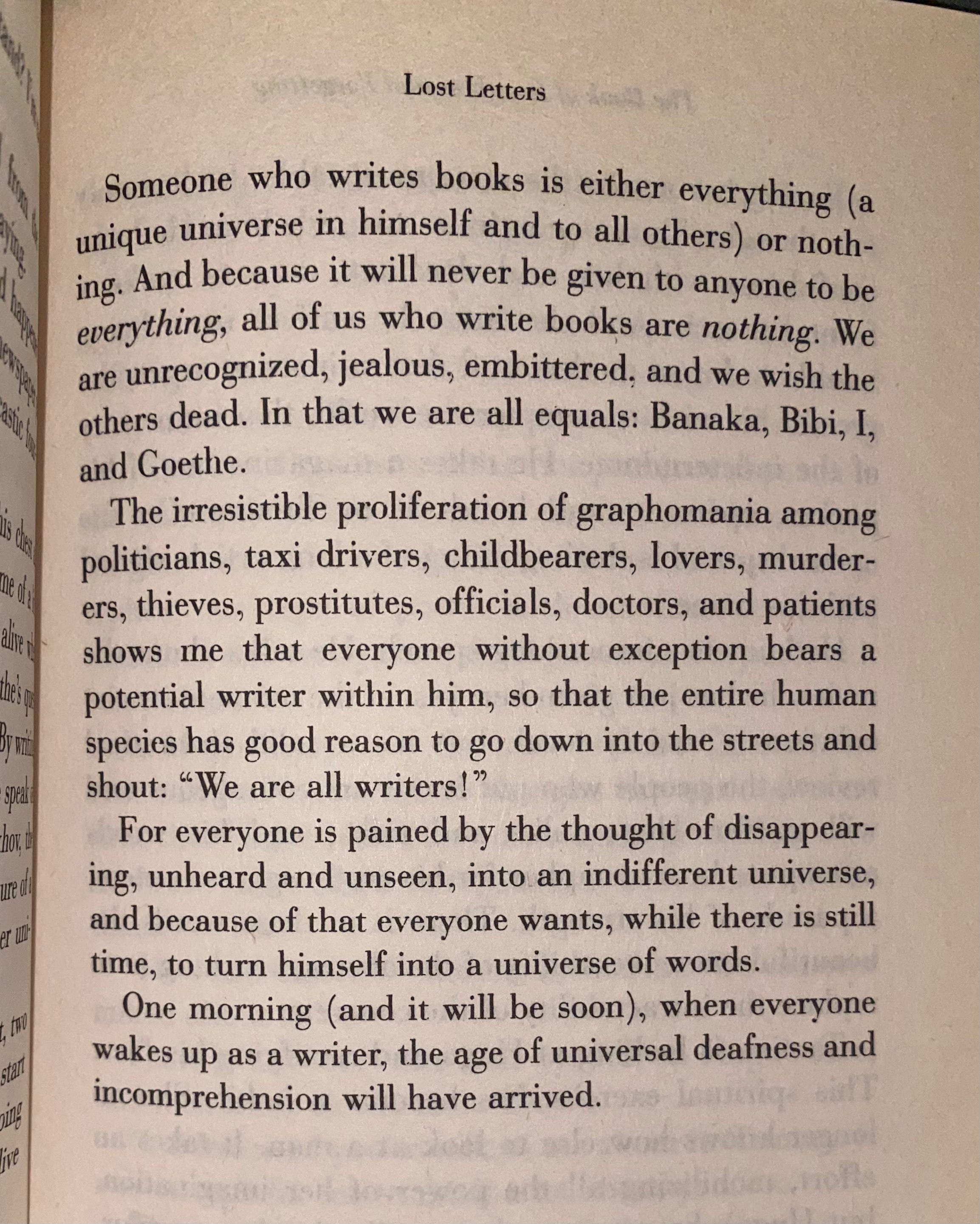
“One morning (and it will be soon), when everyone wakes up as a writer, the age of universal deafness and incomprehension will have arrived.”
“Uh oh,” I thought, when I read that.
It’s probably human nature to be self-centered. That probably has been true since caveman days, and it would probably be ridiculous to blame self-centeredness, as a general concept, on our phones. We are all, quite literally, at the center of the universe as we perceive it. No matter which way you turn, existence stretches out before you. For all intents and purposes, you are the very center.
But it’s never been so easy to project that perspective to an audience. It’s never been so easy to say, “I’m the center of my own life, and let me show you what that looks like, and maybe I can become the center of your life too.”
I don’t think it’s a stretch to extend Kundera’s definition of a writer to anyone producing content. The internet is exploding with books, just in a new form. Almost everyone I know, obviously including myself, has some platform where they share some version of themselves with an audience.
Nearly everyone is seeking to become a universe. Nearly everyone wants to be heard. But you cannot speak and listen at the same time. It’s just not possible.
I’ve been thinking a lot lately about Nietzsche’s idea of the eternal return. I’ve never read Nietzsche and in fact generally struggle with philosophy, but my dear friend Atticus introduced me to the concept.
Here’s the thought experiment, from “The Gay Science”:
What if some day or night a demon were to steal after you into your loneliest loneliness, and say to you, “This life as you now live it and have lived it, you will have to live once more and innumerable times more; and there will be nothing new in it, but every pain and every joy and every thought and sigh and everything unutterably small or great in your life will have to return to you, all in the same succession and sequence” ... Would you not throw yourself down and gnash your teeth and curse the demon who spoke thus? Or have you once experienced a tremendous moment when you would have answered him: "You are a god and never have I heard anything more divine."
I think this is a very beautiful question. I would like to believe that my life is a gift, that it is divine. To me, the fundamental question is, “Am I going to be happy with my life or not?”
Nietzsche’s imperative is amor fati—love fate.
In order to love fate, I think the first important step must be to listen. To observe.
My life, I must remember, is not a background to the drama of my mind. It is not fodder for some future work of genius I will write. It is not a boundless photo opportunity. It is my life. It intersects delicately and sometimes significantly with the lives of other people. It holds richness so far beyond myself that I will never see if I don’t stop to listen.
I was talking about all of this with my boyfriend when an ant scurried across the floor of my bedroom. “Ah!” I shouted. “An ant!” My brain went to infestation, to texting the landlord, to vacating the apartment for 4-5 hours for the exterminator.
My boyfriend quoted Hesse to me: “Every experience has its element of magic,” he said. “Every ant has its element of magic.”
I looked a little closer. “Yes,” I agreed, “the ant has its element of magic. It moves so gracefully.” Six tiny legs carried it with astonishing speed toward its ever-changing destination. I remembered that a single ant is not really a creature to itself, but a tiny part of one super organism, a colony, in the same way that our cells are living parts of us.
I’m not trying to argue against writing, or even against social media. That would be more than a little hypocritical. Thank God for writers. Thank God for Milan Kundera. Thank God for books, in all their forms.
I’m not arguing against personal ambition either, or against the dazzling desire to become a universe of words. That’s something I want, too. I want to twist the circumstances of my life into something digestible and meaningful and true. But how can I do that if I miscast all the characters? How can I be a writer if entire babies escape my attention?
In my quest to write a great book, or even just a good book, I tend to view life as a story. I want to study it from a craft perspective, to learn how it all fits together. But some things don’t fit together in the way I might expect. In the case of my coworker, the story of my own past overwhelmed the reality of the people in front of me. I let myself create a narrative, and I neglected to be curious about the truth. How many elements of magic did I miss?
And—look—here’s the truly shameful admission: I think I could be happy if I never wrote anything worthwhile. I think perhaps I am my own most important audience. I would rather be blind to a book than a baby. That’s all I’m saying.
What I made
I have some food to share with you all!
Blueberry scones:
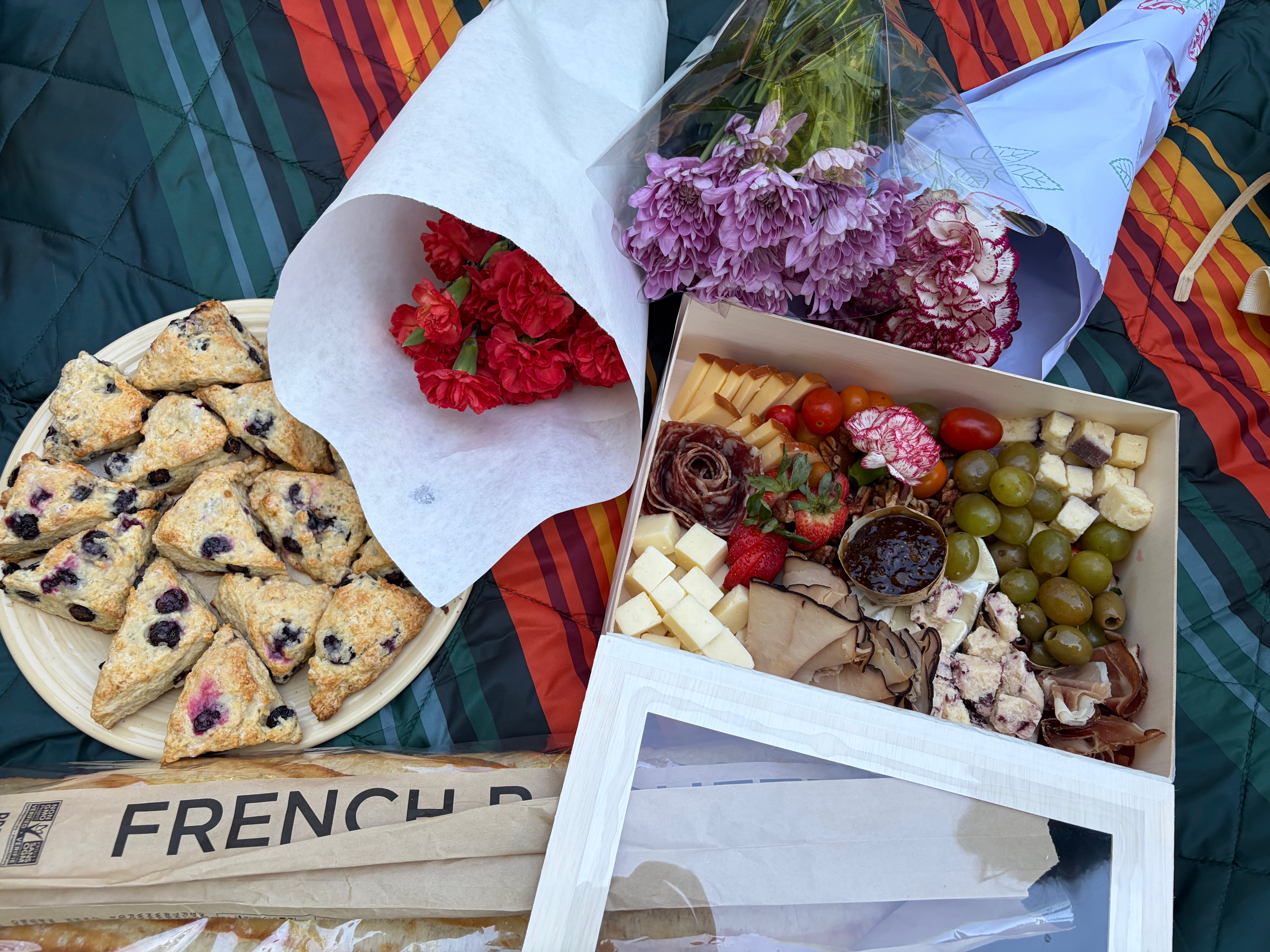
My friends and I had a picnic recently, and my boyfriend and I decided to bring some homemade scones! The restaurant where I work has an afternoon tea service, so I had been craving scones for a while. We initially tried to make raspberry scones, but… something went wrong. I guess the raspberries added too much moisture to the dough, because no matter how much extra flour we added (and we had even used less liquid than the recipe called for!), the dough just would not come together. Eventually, we had to give up, because the dough tasted like straight flour and was still miles away from workable. Luckily, we had enough ingredients left over to make a second batch, so we pivoted to blueberry scones with a lemon glaze. They were a delicious part of a wonderful potluck picnic, including a beautiful charcuterie board, yummy baguettes, cookies, and cheeses. Picnic season is upon us!
Mushroompalooza:


I love mushrooms and decided to gift myself a mushroomy week, with mushroom pasta and tofu steaks with mushroom sauce. I truly don’t understand how anyone could dislike a mushroom.
PB+J failure:
Every day, I take a PB+J to work. It’s easy and fast and satisfying and it doesn’t need to be refrigerated or heated up. An ideal work lunch. I like to include some chia seeds in my sandwich to make it a bit more filling and to add a fiber hit. I know some might balk at the thought of improperly soaked chia seeds, but I figure it’s sitting in the jelly all day, it’s probably good enough. I’ve certainly never had any issues arise. As I was adding the chia seeds to my sandwich, my hand slipped, and, well, this was the result:
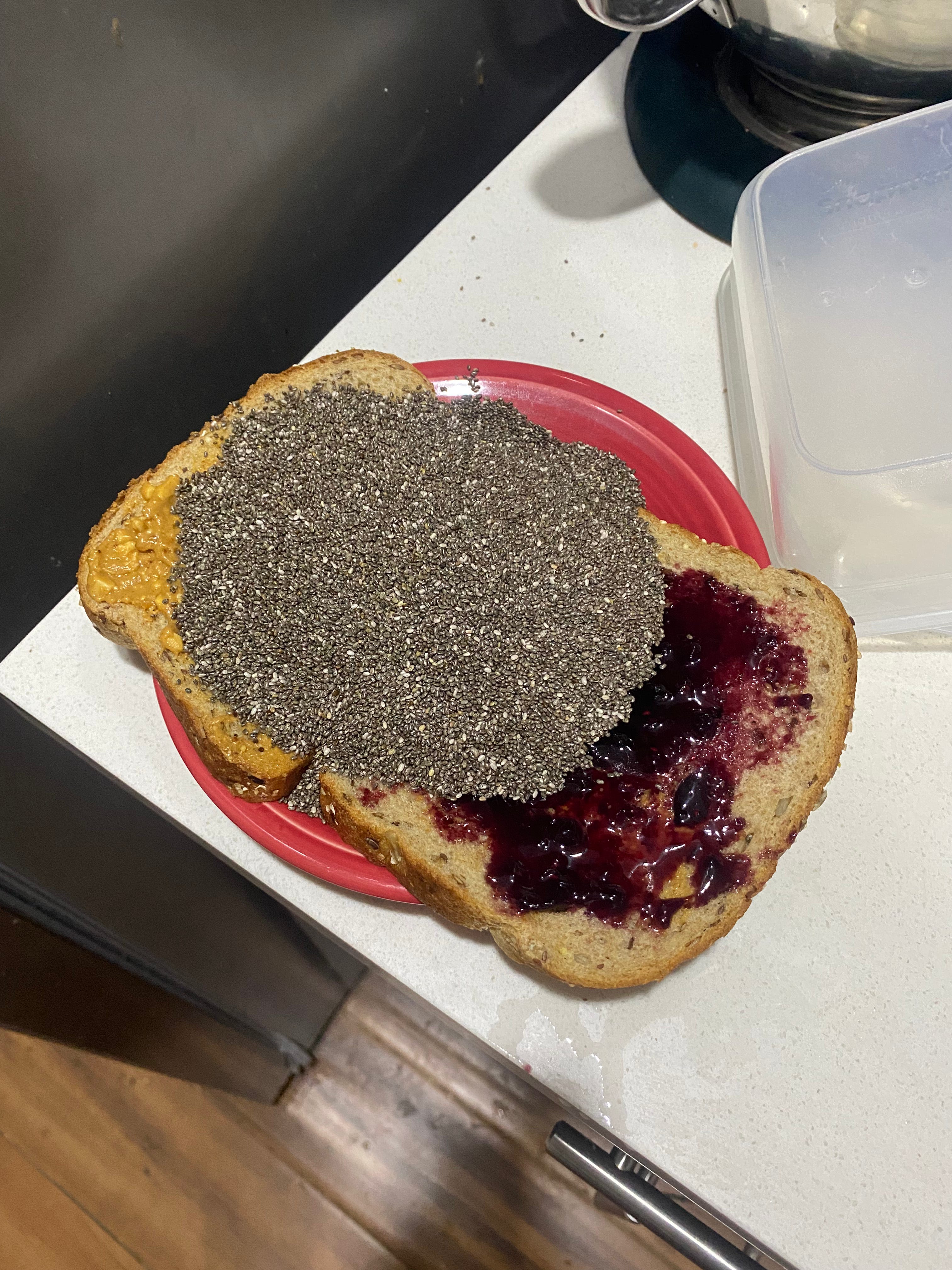
Okay, so maybe that’s a bit too much chia. I wound up scraping off the excess and making chia pudding with it.
Some bits and bobs
A very famous, beloved singer has been calling in to the restaurant where I work and ordering soup to go. His assistant comes and picks up the soup, then brings it to the famous singer, who lives not far from the restaurant. The famous singer is very nice over the phone, and he always goes out of his way to tell me his name, along with the fact that he is a singer. Then, he excitedly reads out his credit card number, as well as his phone number, the name of the building where he lives, and his apartment number. If I were a very famous singer, I would NEVER volunteer that information over the phone to some random girl who works at a restaurant. I would be using pseudonyms, voice modifiers, and a burner phone. I find it sort of touching that he is so unconcerned about his privacy.
Much of the philosophy in this essay, including the phrase “amor fati,” was introduced to me by Maria Semple’s Go Gentle. The book opened the world of Stoic philosophy to me, and it is one that I find fascinating and powerful, and that I am only starting to explore.
While my boyfriend and I were walking to the picnic with our scones, a bird pooped directly onto them. Luckily, we had the foresight to wrap the scones in cling film. Moral of the story, protect your scones.
Thank you for reading! :)
P.S. Here’s a transcription of the Kundera excerpt:
Someone who writes books is either everything (a unique universe in himself and to all others) or nothing. And because it will never be given to anyone to be everything, all of us who write books are nothing. We are unrecognized, jealous, embittered, and we wish the others dead. In that we are all equals: Banaka, Bibi, I, and Goethe.
The irresistible proliferation of graphomania among politicians, taxi drivers, childbearers, lovers, murderers, thieves, prostitutes, officials, doctors, and patients shows me that everyone without exception bears a potential writer within him, so that the entire human species has good reason to go down into the streets and shout: “We are all writers!”
For everyone is pained by the thought of disappearing, unheard and unseen, into an indifferent universe, and because of that everyone wants, while there is still time, to turn himself into a universe of words.
One morning (and it will be soon), when everyone wakes up as a writer, the age of universal deafness and incomprehension will have arrived.
much to think about. and protect those scones!
Oh, my. Sylvie, this is exquisite. I love it. What a profound glimpse into your life.